
Leverage is one of the first things new forex traders hear about. Put simply, leverage lets you control a larger position with less capital, because your broker effectively lends you the difference.
In this guide you’ll learn:
- What leverage is and how the maths works (with real examples)
- Why leverage magnifies losses just as much as profits
- The difference between margin and leverage
- Six risk-management rules that separate traders who survive from those who don’t
With 20:1 leverage, for example, you can control a £20,000 position with just £1,000 of your own money.
That sounds like an advantage, and, it can be. But it is important to note that leverage magnifies your profits when you’re right, and it magnifies your losses by exactly the same amount when you’re wrong. It is a double-edged sword.
Forex is known for offering high leverage ratios, anywhere from 30:1 up to 500:1 or more, depending on your broker and the country it’s regulated in. Those numbers vary a great deal, and the difference matters enormously for how much risk you’re taking. In the UK, the FCA caps retail leverage at 30:1 on major currency pairs; Australia’s ASIC applies the same 30:1 limit; and unregulated or offshore brokers may advertise 500:1 or higher.
By the end of this guide you’ll understand what leverage actually is, the maths behind how it works, and what the different ratios mean allowing you to make educated decisions on your own trades.
How Leverage Works: A Step-by-Step Breakdown
Leverage is closely tied to a second concept, “margin”. It is important to understand their differences.
Margin vs. leverage
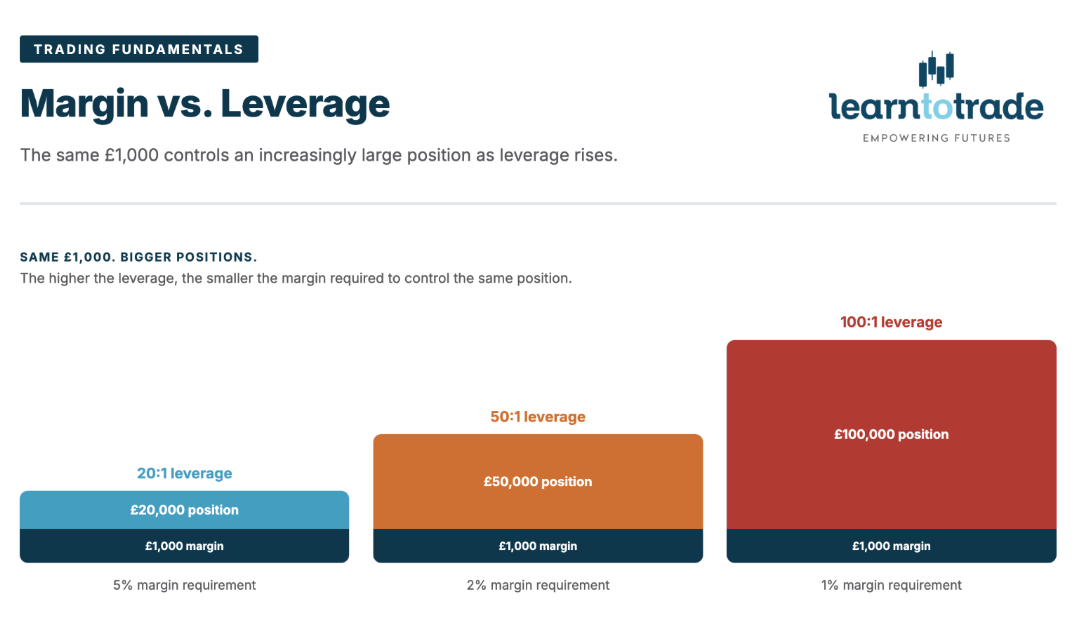
Margin is the cash you deposit with your broker to open and hold a leveraged position. Think of it as your “skin in the game.” Leverage is simply the ratio between the size of the position you control and the margin you’ve put up.
Therefore: Leverage = position size ÷ margin deposited.
If you control a £100,000 position with £1,000 of margin, that’s 100:1 leverage. The higher the leverage, the smaller the margin required:
- 20:1 leverage → 5% margin requirement
- 50:1 leverage → 2% margin requirement
- 100:1 leverage → 1% margin requirement
Example 1: a small win (conservative leverage)
Say you have a £1,000 account and open a EUR/USD trade at 10:1 leverage, giving you a £10,000 position.
If EUR/USD moves 1% in your favour, your position gains £100. That’s a +10% gain on your account. A 1% market move became a 10% account move, because your position was ten times the size of your margin.
Example 2: a loss (same leverage)
Now the same trade, but the market moves 1% against you. Your position loses £100. a –10% hit to your account, leaving you with £900.
The key point: a 1% price movement caused a 10% swing in your account. Leverage works in both directions, equally.
Example 3: high-leverage blow-up (50:1)
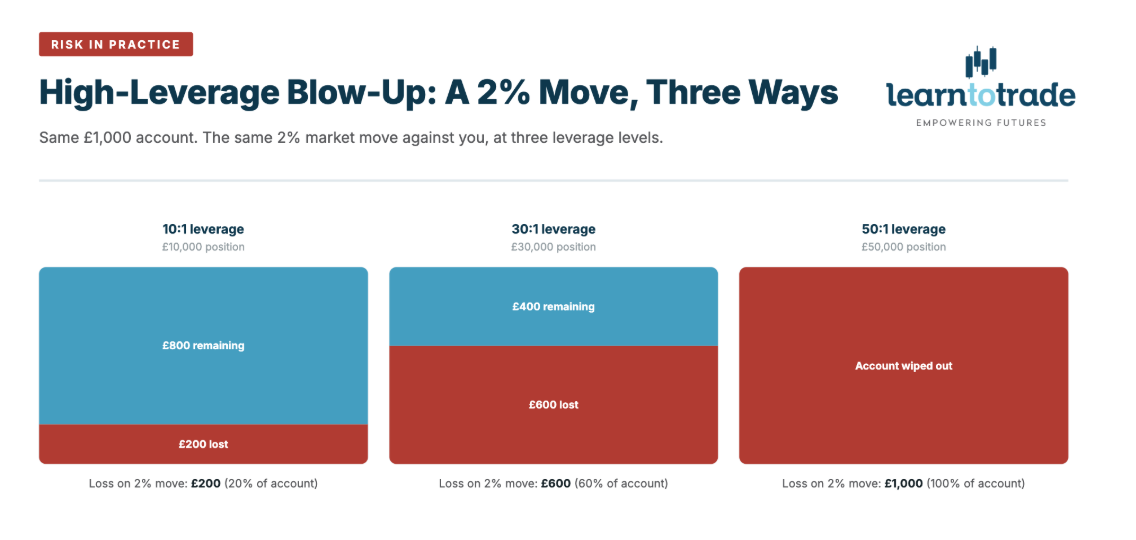
Here’s why the ratio matters. Same £1,000 account, but this time at 50:1 leverage. That’s a £50,000 position. Now a 2% move against you wipes out the entire £1,000 (2% of £50,000 = £1,000). Account gone.
And a 2% move isn’t rare. On major pairs it happens multiple times a month. This is exactly why high leverage can be so dangerous for beginners.
Leverage Ratios & What They Mean
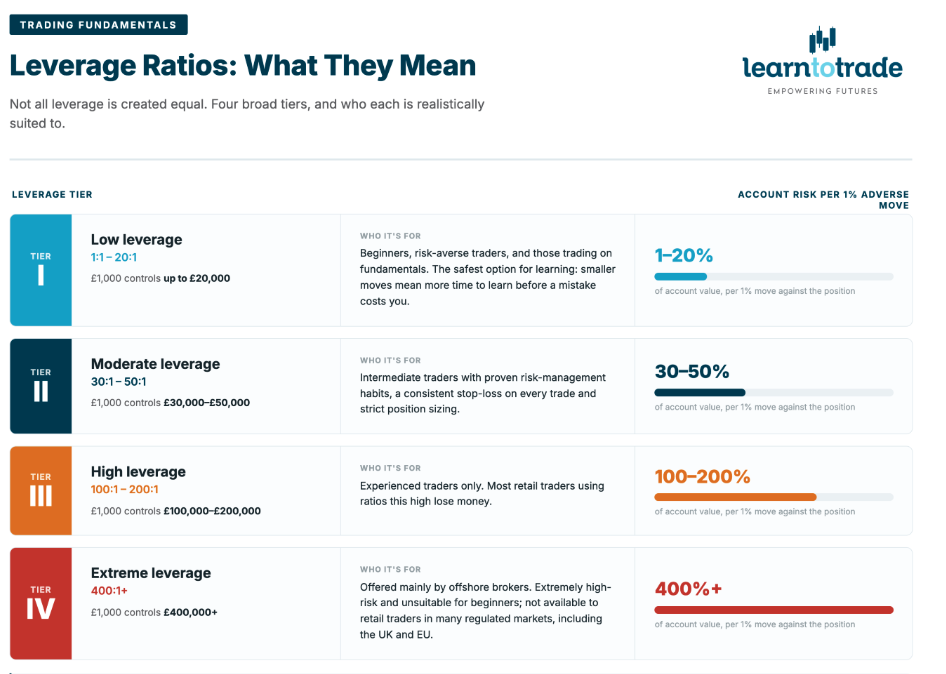
Not all leverage is created equal. Here are four broad tiers and who each is realistically suited to.
Tier 1: Low leverage (1:1 to 20:1). The safest option for learning. £1,000 controls up to £20,000. Ideal for beginners, risk-averse traders and those trading on fundamentals. Smaller moves on your account mean more time to learn before a mistake costs you a lot, which is why Learn to Trade encourages new traders to start here.
Tier 2: Moderate leverage (30:1 to 50:1). A more balanced risk-reward profile; £1,000 controls £30,000–£50,000. Suitable for intermediate traders who already have proven risk-management habits, a consistent stop-loss on every trade and strict position sizing.
Tier 3: High leverage (100:1 to 200:1). For experienced traders only. £1,000 controls £100,000–£200,000, where a 1% market move against you can wipe out 100% of your account. The reality is that most retail traders using ratios this high lose money.
Tier 4: Extreme leverage (400:1+). Offered mainly by offshore brokers, this is extremely high-risk and unsuitable for beginners. It is not available to retail traders in many regulated markets, including the UK and EU.
A note on regulation (verify for your region): As of 2026, the UK (FCA) and Australia (ASIC) both cap retail leverage at 30:1 on major currency pairs (with lower caps on minors, commodities and shares). In the Philippines, retail margin forex is not licensed for the general public and the SEC has repeatedly warned against unlicensed schemes; Filipinos who trade via offshore brokers offering 500:1 do so outside local protection. Always check the rules and the regulator that apply to you.
The Genuine Benefits of Leverage
Genuine advantages:
- Lower capital entry: you can start trading with £1,000 rather than needing £50,000 outright.
- Capital efficiency: you can use your capital across several positions instead of tying it all up in one.
- Portfolio flexibility: smaller position sizing lets you diversify across currency pairs.
What leverage does not do (and this is the part the hype leaves out):
- It does not increase your skill.
- It does not guarantee profits.
- It does not reduce the risk of being wrong.
Leverage gives you flexibility. But flexibility combined with poor risk management is a recipe for disaster. That’s why disciplined traders treat leverage as a tool that comes second (after the risk-management rules that keep an account alive).
The Risks: The Part That Matters Most
If you read only one section, read this one.
The core risk is magnified losses. Losses scale at exactly the same rate as profits. A 5% move against a 100:1 leveraged position is a 500% loss, which is far more than your account holds. This leads directly to the single most important mechanic to understand:
Risk 1: the margin call
A margin call is when your broker forcibly closes your positions because your account balance has fallen below the required maintenance margin. Consider: a £1,000 account, 50:1 leverage, a £50,000 position, and no stop-loss set. The market moves 3% against you (a £1,500 loss on a £1,000 account). Your balance is now –£500, the margin call triggers, and the broker liquidates your position.
Risk 2: overnight gap risk
Markets close Friday afternoon (New York time) and reopen Sunday evening. Prices can gap 1–3% over the weekend on geopolitical news, and a stop-loss does not protect you if the market jumps straight past it. For example, during the 2016 Brexit vote, GBP gapped roughly 3,500 pips in minutes; traders holding highly leveraged positions saw entire accounts wiped out.
Risk 3: the psychological loss spiral
High leverage means large swings in your profit and loss, and large swings drive emotional decisions such as revenge trading, over-sizing the next position to “make it back.” Lose £100 on one trade, risk £500 on the next, and discipline collapses under stress. Leverage doesn’t just magnify money; it magnifies the pressure on your judgement.
Risk 4: slippage and execution
In fast-moving markets, orders can execute at a worse price than you expected. With 100:1 leverage, even 10 pips of slippage can mean an instant £100 loss. Brokers with poor execution can quietly erode leveraged accounts over time.
Risk Management: How to Use Leverage Safely
Leverage is only safe alongside discipline. These six habits are the foundation of that discipline and together they form the backbone of a proper forex trading plan.
- Position sizing:the 1% rule.Risk no more than 1% of your account on any single trade. On a £10,000 account, that’s £100. If your entry is 1.0900 and your stop-loss is at 1.0850 (50 pips), your position size is £100 ÷ 50 pips = £2 per pip. That is roughly a £20,000 position, only about twice your account.
The insight most beginners miss: proper position sizing naturally limits how much leverage you actually need.
- Stop-loss ordersshould bemandatory. A stop-loss is a pre-set order that closes your position at a defined loss level, capping your downside to a known amount. Never trade without one.
- Account management.Never risk more than 2–5% of your accounton a single position and remember that even with perfect risk management, you will have losing streaks. Three consecutive losses at 1% risk each is a manageable 3% drawdown. Three at 10% risk each is a 30% loss which is much harder to recover from.
- 4. Diversification.Don’tput all your capital in one trade. Three positions at 1% risk each is 3% total exposure. This is safer than a single position, risking 3% on its own.
- 5. Risk-reward ratio.Aim for a minimum of 1:1 (risk £1 to make £1), ideally 1:2 or 1:3. A good risk-reward ratio keeps you profitableeven at a 50% win rate: over 10 trades with 5 winners and 5 losers, risking 1% to make 2%, you net (5 × 2%) − (5 × 1%) = +5%.
Risk-management beginners guide at a glance
| Rule | Guideline | Why it matters |
| Risk per trade | Max 2% of account | Survives long losing streaks |
| Stop-loss | On every trade, no exceptions | Caps loss to a known amount |
| Max single-position risk | 2–5% | Prevents one trade sinking you |
| Risk-reward ratio | 1:2 or better | Profitable even at a 50% win rate |
| Total open exposure | Diversify across pairs | No single event wipes you out |
| Before live trading | 50+ demo trades | Build the habit before real money |
A trading plan is simply these rules, written down and followed on every trade. Learn to Trade’s trading plan template builds them in. The point is to automate discipline so it doesn’t depend on how you feel in the moment.
Forex vs. Equity Leverage: Why Forex Is Different
New traders are often surprised at how much higher forex leverage is than stock leverage:
- Forex leverage: retail forex commonly ran from 50:1 to 500:1 historically, though the UK and Australia now cap it at 30:1 on major pairs.
- Equity (stock) leverage: is much lower, typically around 2:1 to 5:1 for retail traders.
Why the difference? Forex is highly liquid and, intraday, tends to move in smaller percentage increments than individual shares, and it trades 24 hours a day, five days a week. That relative stability is why regulators permit higher leverage on major currencies.
Frequently Asked Questions
Can I start with high leverage (100:1) if I’m disciplined? Discipline is necessary but not sufficient. Even disciplined traders lose money with high leverage, because a single ordinary market move can be fatal. We recommend that you start at 10:1 or 20:1 and only increase once you’ve proven you can be consistently profitable at low leverage. And always remember not to trade money you can’t afford to lose.
Why does my broker offer 500:1 if it’s so dangerous? Because a broker earns fees and spreads on your trades regardless of whether you win or lose. Higher leverage means larger positions, more spread, and faster account turnover. Some brokers profit from leverage-driven losses.
What happens if I run out of margin? You get a margin call: the broker force-closes your positions, often at a poor price. In fast markets your account can even go into a negative balance, meaning you’d owe the broker money. Unregulated brokers may not stop you from going deeply negative.
Is leverage required to trade forex? No. You can trade at 1:1 (controlling £1,000 with £1,000 of capital). Leverage is optional, it’s useful for capital efficiency, not required for profitability.
How much leverage should I use as a beginner? Start at 10:1 or lower and trade for 3–6 months. If you’re consistently profitable and rarely hitting stop-losses, you might step up to 20:1 or 30:1. Never increase leverage because you’re impatient, or because “everyone else uses more.”
Conclusion: Discipline First, Leverage Second
Five things to take away:
- Leverage is a tool and tools can hurt you if misused.
- High leverage doesn’t make you more money. Discipline does.
- Risk management is key. The 1% rule, stop-losses, position sizing matters more than the leverage figure.
- Most retail traders fail because they use leverage designed for professionals.
- Start low, prove your strategy works, and increase leverage only incrementally, if at all.
Full risk disclaimer
This article is educational content and does not constitute financial, investment or trading advice. Forex and CFD trading carries a risk of loss and is not suitable for every investor. Leverage magnifies both gains and losses. Leverage limits, product availability and regulation vary by country and change over time. Verify the current rules with your local regulator. Trade only with capital you can afford to lose, and seek independent advice if you are unsure.